April 30, 2012

Recipe 17: Sanguinella (Blood Orange)

So apparently I haven't posted a recipe in a while.  I've been playing with citrus juices lately, and I've been close to posting a couple of tasty recipes, but they're not quite complete yet.  I'll post this one because I'm satisfied with the way the syrup turned out.  I'm going to see if I can get some citric acid to adjust the syrup, and make it super tasty.

I found some blood oranges at Wal-Mart of all places, and I couldn't resist picking up a bag.  It's been a while since I had a good sanguinella, though if I remember right, San Pellegrino has a good one.  Update: Yes, I found some in cans at Wegman's, I'll have to add that to the taste test mentioned below.

So here we have one orange juiced and three more ready to go.  I peeled these, sectioned them and put them in a blender after removing as much pith as I could.  That may or may not have been a good idea.  That bitter pith flavor still comes through a little bit, perhaps it's from the pulp.  Makes you feel like you're eating a fresh orange, though, so if that's what you're going for, then great!

From these three oranges, I ended up with about 1 cup of juice.  I was a little shy of the 1 cup mark, so I made up the difference with lemon juice to add some extra tartness. 

After squeezing the juice through a clean juicer bag to separate out the pulp, I added that to some invert sugar syrup scaled for a gallon of finished soda.  (Invert Sugar Recipe, thanks to Chef Eddy).  Add the juice to the hot syurp to kill any natural yeasts and then add that to your carbonated water.  Done.

1 cup Blood Orange Juice mixed with Lemon Juice for added tartness, ratio depends on desired tartness
2 cups sugar, inverted

Top up to 1 gallon with carbonated water.

I'm fairly happy with how this turned out, it could have used the citric acid that I wanted to add, but didn't.  I have some Blood Orange Monin syrup to compare it to, and I'm waiting for the right time to do a side by side taste test.

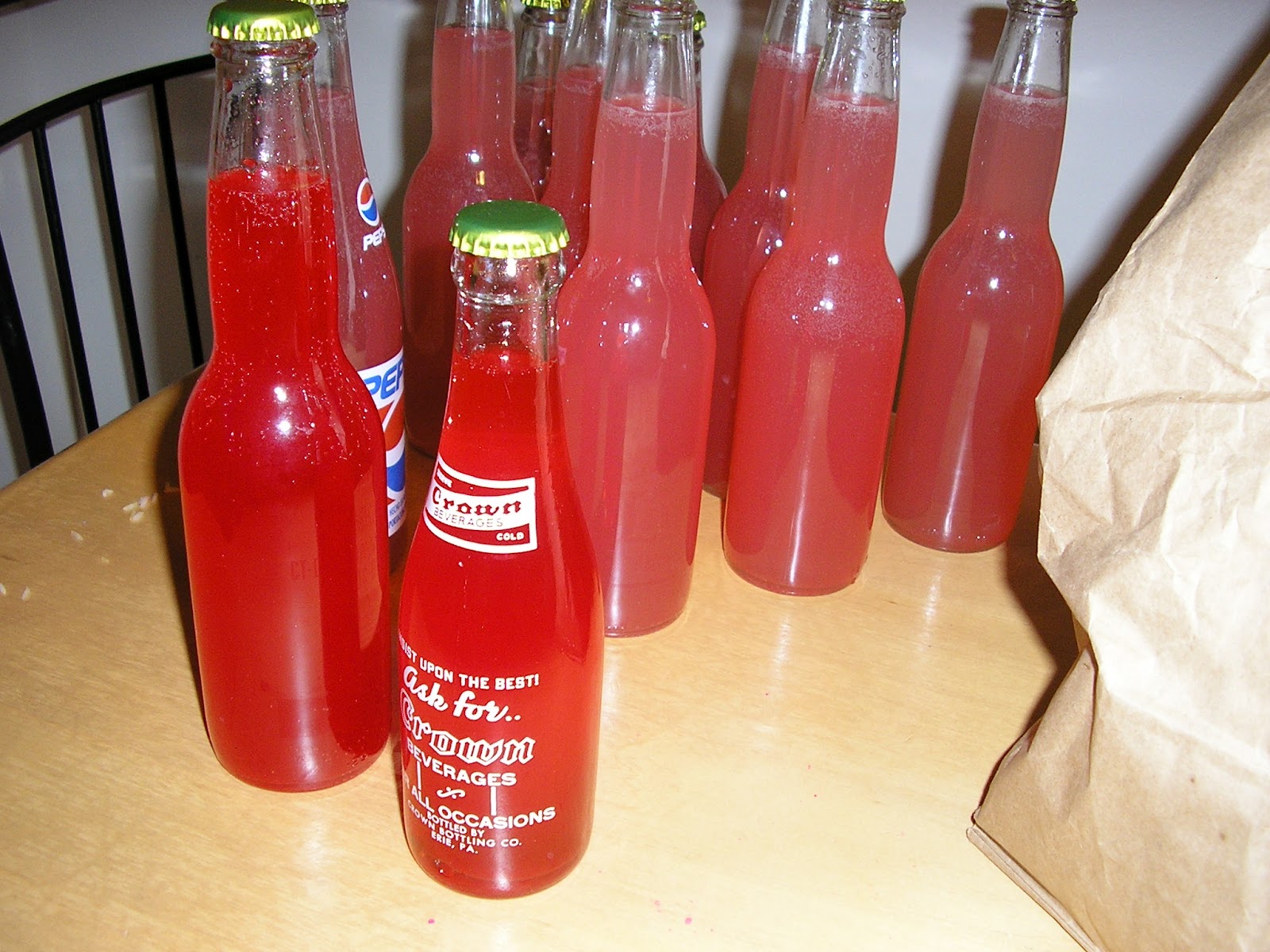
 When I bottled this, I was very impressed at first with the color of the two syrups.  Pardon the blurry photo, but right is my syrup and left is Monin's syrup.  Monin's is a little darker, but not by much. 
 Here's a clearer photo, monin is the bottle at left and the one with the funnel behind.


 Once filled the Monin was still a bit darker, not to mention clearer than mine.  Those natural colors do dilute quite readily, apparently. 
As far as taste goes, I have yet to really taste them side by side.  I have to get my hands on the San Pellegrino.  But it does seem like the Monin has a "brighter" orange flavor.  Mine is a bit more "dull" and ever so slightly bitter, like biting into an actual orange, not just sipping the juice.  Still pretty good if you like oranges. 

Update: It's taken me so long to post this, I'm not sure that you can still get blood oranges in the store anymore, they're a bit out of season.  But theoretically, this recipe should work well with any citrus juices.  I have some meyer lemons that are aching to be used in a beverage that I'm planning on trying out rather soon.  We'll see if the recipe still holds up there.

April 24, 2012

The Artisan Soda Workshop by Andrea Lynn

Edit: For those of you returning here, the release date for this has been changed from May 29th to July 10th.  The Kindle edition is apparently already available, but physical book in hand is not.

I figured it was about time to post something.  There are a number of recipes that I've been working on, but I want to polish them up before posting.  So in the meantime, I also wanted to take a minute to let people know that in searching for homemade soda recipes, you're not alone.  I'm very much a DIY'er, and it seems it's common among those of my generation.  If you're reading this, you're probably part of that generation.  I've seen a steady increase in traffic, and I'd like to thank the internet community for taking an interest in what I have to share!  I associate the increased interest in homemade soda with what Wired Magazine calls the Next Industrial Revolution which is a really cool article if you have the time to make it through it.  Who knew cars could be crowdsourced?  There seems to be a constant and welcome increase in information available on homemade soda.  With the release of Andrew Schloss's Homemade Soda book last year (which I reviewed here, excellent book by the way) my library for homemade soda books doubled. 
It seems that there's more to come with Andrea Lynn's The Artisan Soda Workshop.

This doesn't become available until the end of May, but you can be sure that I'm going to get my hands on a copy to add to my library.  When I do, I'll post a full review for all folks interested.  It promises some very interesting recipes, for sure.  Rhubarb Basil sounds interesting, I'm not sure it would be something I'd consumer regularly.  Sea Salt Lime sounds scary, I've tried salting my butterscotch/butterbeer recipes and that never ends well.  Prickly Pear and Plum Lemon sound really tasty!  Lemon-Thyme sounds like it's a maybe.  As in, this may be the drink you never knew you loved.  But maybe not.  It looks like I'm going to have to wait until May to find out.  I'm definitely stoked, though. 

So, to recap, here's the dedicated soda books that I know of:

1998 Stephen Cresswell's Homemade Root Beer, Soda & Pop  Classic, great basis for making soda.
2010 Darcy O'Neil's Fix the Pumps More of a history, as I understand.  Still need to get my hands on this.
2011 Andrew Schloss's Homemade Soda Lots of great recips, highly recommended.
2012 Andrea Lynn's The Artisan Soda Workshop We'll see how it ranks come May 29th.

Hmmm, I see a trend.  What will 2013 hold I wonder?  If these Artisan recipes from Lynn are any indication, I think we'll be seeing some wild combinations soon.  That said, any ideas for great, wild recipes posted in the comment box will recieve some serious consideration. 

January 10, 2012

Ball Lock Keg O-rings For Sale

The Homemade Soda Expert is pleased to offer ball lock keg o-rings for sale!

When buying used pre-mix soda tanks, some of the seals are in less than perfect condition.  I opened my own up recently and found the dip tube o-rings to be kind of gunky.  I just needed the dip tube seals, but it seems that no-one really offers just those.  I'd have to buy a whole kit, and you don't really find savings on ordering multiple kits.  The lid o-rings tend to hold up rather well, so I don't anticipate needing one for some time.  The bottom line is that I saw a number of needs that needed filled.  Now I'm glad I can fill them. 

Available for sale are full kits of Buna-N o-rings which include one lid o-ring, two post o-rings, and two dip tube o-rings.  These are all the seals on a keg.  I am offering one kit for $3, two kits for $5.50, three for $7.75, or four for $10.  Not a huge savings at each step, but in this economy, every little bit helps.  These fit ball lock kegs, I don't have any pin locks, so I don't feel comfortable selling pin lock kits just yet.  Maybe in the future when I have something that I know I can test them on. 

Because the dip tube o-rings are the first to wear out, followed by the post o-rings, I'm offering smaller kits as well.  That way you don't end up replacing a perfectly good lid o-ring if you don't need to.  A pack of post and dip tube seals with enough for 5 kegs or a pack of just dip tube seals for 10 kegs are each $3

You will see a paypal button in the sidebar that will be there permanently. 

These will also be available on ebay, if you're worried about a blog not being a secure market place.  Look for supramansquee as the seller.

I hope to be able to offer other products in the future, I don't think this will ever bloom into a full blown homebrew store, but I'd like to maybe sell some bottle caps and other items eventually.  Comment below if there's anything you'd like to see sold here.

January 5, 2012

Syrup Review: Master of Mixes Cocktail mixes

So every time I pass the beverage aisle at the grocery store, I see the cocktail mixes and think, "A piña colada soda would be really tasty."  So my birthday rolled around and I thought it would be a great time to put it to the test.  We picked up a bottle of piña colada mix and a bottle of strawberry margarita/daiquiri mix. 

Regrets are usually prefaced by "It seemed like a good idea, at the time" 

So, it seemed like a good idea at the time.  I think this, and the coconut flavored La Croix I had over the holiday have kind of turned me off of coconut for a while.  I seem to still be ok with coconut and lime together, but on it's own, or apparently with pineapple, it doesn't seem to go down as smooth.  I think it reminds me too much of lotion. 

Aside from the coconut flavor, I do have some problems with the Master of Mixes.  There's an off flavor in each of the mixes I bought.  It's almost a salty flavor that I can't quite put my finger on.  The body of this syrup is great, for syrup.  I'm sure it works great blended with ice, but it just doesn't mix well with seltzer.  It sinks even with some agitation.  With enough agitation to get it blended, you lose your carbonation rather quick.  The strange thing to me is that one of the first ingredients listed is HFCS, but for how thick it is, it doesn't seem to be very sweet.  I can't quite figure that one out.  The coconut cream certainly is not water soluble, so it leaves a bit of a bubbly sludge on your glass.  The strawberry is made with real strawberries, which is always a good thing, but I know my kids don't like the sediment.

I think that I may try some other brands of cocktail mixes, but the Master of Mixes is definitely off my list.

So the Master might be mixing up some tasty cocktails, but as for soda, that's best left to the experts. Not to toot my own horn or anything.

November 29, 2011

Holiday Gift Ideas for the Soda Maker in all of us!

As Christmas gets closer and everyone is scrambling to come up with gift ideas for those difficult people on their lists, I thought I'd help some people out.  For the soda jerk on your list, or any jerk or non-jerk for that matter, here are some essentials that no homemade soda maker should go without. 

First on the list is ready made syrups, Monin has a very nice selection of 102 full sugar syrups from basic to floral to fancy including some nice holiday flavors.  I've been working on a pumpkin pie soda, but it's just not working out.  I suppose this is the next best thing, they have a pumpkin spice and a newer pumpkin pie:

Torani is another great syrup manufacturer. They have about 75 full sugar syrups.  Most of these are more traditional cafe flavors, but some like Bacon seem to stand out. 

For those looking to make their own syrups, there are a miriad of options.  One that I've been meaning to try is using flavoring oils.  LorAnn oils has a nice selection of candy, beverage, and chocolate flavors.  They're super concentrated, so you you're not paying for excess sugar and water, you can add that yourself.  Choose individual flavors, or blend them to create your own.  These would be helpful in creating that supposed secret Coke formula floating around the internet that uses cinnamon oil, nutmeg oil, and some various citrus oils.


If you're unsure about mixing oils to get a flavor base, you can use some more water soluble options from Rio.  These are available from the Praire Moon company.  These are normally sold as snow-cone flavoring mixes, but work well for homemade soda.  I had some friends in high school that earned money over the summers with a shaved ice stand by the city pool.  They had the best shaved ice around, that's for sure.  They used some of these syrups for their shaved ice, and they are quite tasty.

In my opinion no one serious about homemade soda should go without a keg system.  There is a sense of superiority and control that comes with kegging.  You can keg what you want, in what quantity you want, with the exact amount of fiz that you want, and you can dispense as much as you want without losing carbonation.  Granted it doesn't fit on your countertop like a Sodastream might, but who wants more gadgets cluttering up your counter anyway. 
Ball lock kegs are becoming increasingly hard to find, and the price keep going up on used kegs, but new kegs seem to be coming down in price.  I imagine supply and demand will eventually even that out.


Anyone Bottling should have some nice nostalgic bottles.  You can dig up old ones, and worry about what gunk might be in them, or you can get some new 187 mL champagne bottles in either clear to show off your colorful sodas, or green to hide your less than desireable colors.


Another great bottling option is the 125th anniversary Coke Hutchinson Bottles available this year.  I've seen these in four packs at the local Wal-Mart, though I can't find a link for you online.  These are limited release, but would make great additions to anyone's bottle collection.  Soda maker or not, these are just neat.


And of course there's always the old standby, Martinelli's.  These are one of the few recappable bottles widely available.  And for the Holidays, why not.  I'm assuming that both the 8 oz and 24 oz are recappable.  I don't see why they wouldn't be.  Anyone with any input, feel free to comment.

Of course, if you're going to bottle, who doesn't need more caps.  If you're looking for the most inexpensive option, MoreBeer! seems to have the best price, particularly on their overrun caps, though they're not always in stock.  If you're looking for some more personalized options, most homebrew shops have various colors.  For something completely custom, you can try BottleMark, Crafty Caps, or Brew Toppers.


And of course you'll need something to get those caps off.  StarrX bottle openers are classic, and you can find some cool vintage ones on Ebay occasionally.  You can also get them new for your home bar, soda fountain, or I've thought about attaching them to a wooden crate to take bottles to parties and gatherings.


If you want to get started, I'm sure Andrew Schloss can help.  His book is very handy and has lots of great recipes that are great alone, or as inspiration to build your own.  With 200 recipes total, this book will keep any soda maker busy for a while.  These recipes are focused mainly on using carbonated water or a soda siphon, but there are a fair number of brewed beverages here as well.

If you want to stick with brewing and bottling, nothing is as classic as Stephen Cresswell's book.  This book got me started and I still refer to it.  Great root beer recipes and tips on bottling, recipe development, and troubleshooting.


So there you have it, that's my 2011 gift guide for soda makers. I hope you found some inspiration for the soda maker on your list.

November 23, 2011

Recipe 16: Holiday Gingerbread Soda

In time for the holidays, here's a lovely concoction for your holiday gatherings.  To adjust to your ideal gingerbread flavor, try varying the levels of molasses, and ginger, as those are the main flavoring components.  The caramel malt adds depth and "breadiness" to the flavor, getting you closer to ginger bread and further from spiced ginger ale.

Gingerbread Soda (makes 1 gallon)

2 1/8 cups sugar
1 cup water
1/4 tsp cream of tartar
1/8 cup caramel malt, cracked
1 tsp ground ginger
1 tsp ground cinnamon
1/2 tsp ground cardomom
1/4 tsp ground clove
2 Tbsp molasses
cold carbonated water up to 1 gallon (2 2-liter bottles)

Combine sugar, water, and cream of tartar, bring to a boil, simmer 20 minutes. Allow to cool. In a separate saucepan, heat 1 1/2 cups water to just before boiling. You will see small bubbles form at the base of the pan, but they shouldn't rise to the top. Turn heat to low to maintain this temperature. Add in the caramel malt and all the spices. Steep for 30 minutes covered. Allow to cool. Strain out the grain and spice sediment and add to the sugar solution with the molasses. Add to carbonated water and mix gently until dissolved.

October 20, 2011

Recipe 15: Halloween Root Beer with Dry Ice

As the harvest season approaches, there are invariably countless Halloween parties at which homemade rootbeer is a staple. I don’t know if it’s the dry ice in the bubbling “witch’s brew” that makes us think of Halloween, or if enjoying a root brew has always been traditional this time of year. One thing is for sure, whenever I think of homemade soda with dry ice, I think of the large orange beverage cooler bubbling at a church Halloween party, with little kids hoping to get just a little sliver of that dry ice in their cup so they can watch it bubble and “smoke” until it quickly disappears.


If you’re planning a party with just such a brew, here are some tips on carbonating with dry ice to get the best carbonation in your beverage.

- A general rule of thumb is 1 lb of dry ice/gallon. This is going to bubble like crazy, so make sure you have a lid for your orange beverage cooler to contain the splashes.

- Also easy to remember is 1 lb of sugar/ gallon. This may seem like a lot, but it is the same amount of sugar as Kool-Aid, so it’s nothing you haven’t imbibed before.

- How much carbonation a drink will hold is mostly a function of temperature and pressure. As the drink gets colder and the more pressure the drink is under, the more carbonation it will hold. Increasing pressure can be difficult and dangerous (especially with 5 lbs of dry ice), placing the lid on the cooler will certainly help, but you’ll get more results with keeping it cold. Dry ice will chill it, but you’ll be much farther ahead if you start out as cold as you can go. Leave it in the refrigerator overnight if you have that much space, or add some of your water as ice. With that much sugar you should be able to get it just below 32 degrees before it freezes.

- You’ll get more mileage out of your dry ice if you don’t add it all at once. Add about 1 lb and stir until it’s gone. The agitation will ensure that you get even cooling, pH adjustment, and carbonation from the first pound, then add the rest and let it sit.

So why does dry ice carbonate water? Dry ice is solid carbon dioxide or CO2, it’s held at a temperature of about -110F. Instead of melting, it sublimates, meaning it goes straight from solid to gas. As the gas bubbles through the water, some of it dissolves into solution, creating carbonic acid, or H2CO3. Carbonic acid readily breaks down at room temperature and pressure to 1 molecule of CO2 and 1 molecule of H2O, carbon dioxide and water. Many people think that the tingle of soda in their mouth is the bubbles, but part of it is the bite of the acid.

5x5 Halloween Root Beer Recipe:

5 gallons water

5 lbs sugar

5 lbs dry ice

5 ounces extract(2 oz rootbeer, 3 oz vanilla)

Combine water, sugar, and extracts in a 6 gallon or larger beverage cooler (you’ll need extra space so it doesn’t bubble over). Make sure this is as cold as it can possibly get, or chill it overnight if you have space. 1-2 hours before serving, add 1 lb dry ice and stir until dissolved. Add the rest of the dry ice and let it sit for the remainder of the serving time.

I wish I had a lovely picture of this, it's always fun to see all that bubbling brew.  Maybe closer to Halloween one will pop up, no pun intended.

Related Posts Plugin for WordPress, Blogger...